
What His Mother Called Lazy
After 25 years of Ivy League admissions consulting, I have watched perfectionism derail more promising students than any lack of talent ever did. Tim's story is the clearest example I have seen.

A pseudonym has been used and identifying details changed to protect privacy.
By Mark Lee · Raising Exceptional / Founder, IvyZen · 20+ years · 1,000+ students placed at top universities
Raising Exceptional is a newsletter for parents of high-achieving students — about the psychology underneath the performance. This is the abbreviated version of Tim's story. The full version is free — just subscribe and you'll have it in your inbox immediately.
The first thing Tim's mother said, when she sat down in my office, was that her son was lazy.
She said it the way people say things they have been thinking for a long time — not with anger, exactly, but with the particular weariness of someone who has arrived at a conclusion through years of accumulating evidence and is now simply reporting it. Her son was lazy. She had watched him work for hours on problems that should have taken twenty minutes. She had watched him erase and redo and erase again. She had watched him miss deadlines not because he hadn't started but because he couldn't finish — couldn't release the thing, couldn't declare it done, couldn't let go.
She was a physics professor. She knew what diligence looked like, and she knew what her son was doing was not diligence. It was something else. She just didn't have a name for it.
I had a name for it.
Tim was a seventh grader at an international school in Seoul when I first met him. He was a soccer player — genuinely good, the kind of player who reads the game two moves ahead — and he had the particular quality of certain athletic kids where the physical confidence and the academic anxiety existed in completely separate compartments, such that you would not, watching him on the field, ever guess that sitting down to write an essay made him feel like he was standing at the edge of something.
He was also, by any reasonable measure, exceptionally intelligent. His performance on the AMC 10 — the American Mathematics Competition, a benchmark that sorts students with unusual precision — was near perfect. Not strong. Near perfect. The kind of score that produces a specific, quiet excitement among the people who know what it means.
And yet here was his mother, telling me he was lazy. And here was Tim, sitting beside her with the expression of someone who has heard this assessment before and has no idea how to argue against it.
I asked his mother to step out. Then I asked Tim to walk me through what happened when he sat down to work.
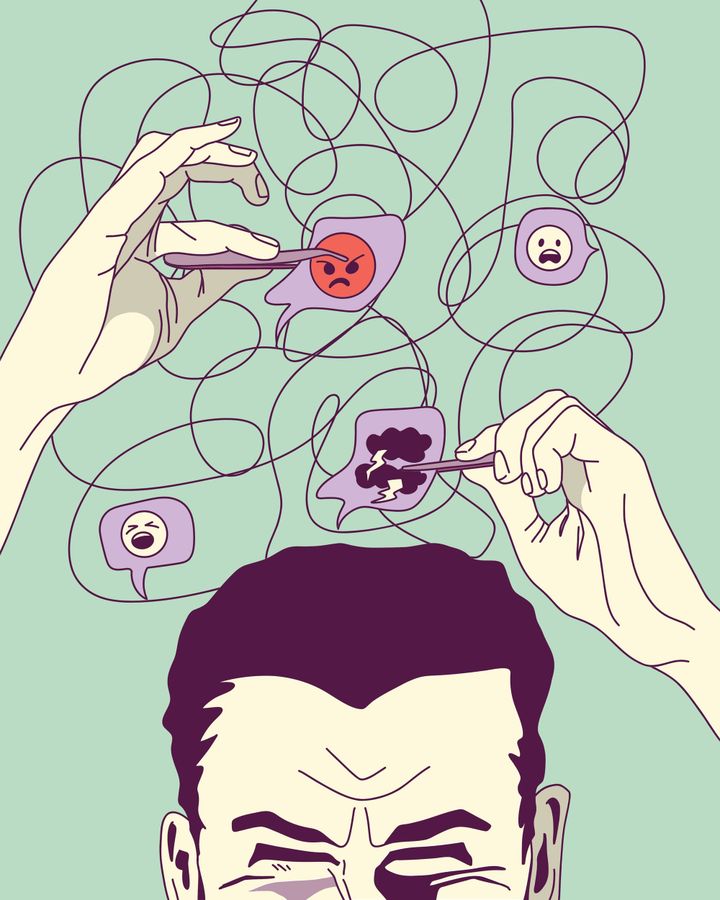
What he described was not laziness. It was a specific and recognizable pattern that the clinical literature calls maladaptive perfectionism — and what it felt like, from the inside, was this: every piece of work he produced felt like a test of something larger than the work itself. Not a test of whether the math was right. A test of whether he was right. Whether he was as intelligent as his score suggested. Whether the person he had been told he was matched the person the work would reveal.
I asked him: when you think about turning something in, what are you actually afraid will happen?
He thought about it for a long time. Then he said: that people will see it's not as good as they think I am.
That sentence is the whole diagnosis.
Perfectionism — the clinical kind, not the colloquial kind — is not about high standards. Everyone in this building has high standards. Perfectionism is what happens when the brain begins to treat the quality of the work as evidence about the quality of the person. When a mistake in the essay stops being a mistake in the essay and starts being a verdict on the self. When submission feels not like completion but like exposure.
The checking behavior that Tim's mother had been watching for years — the erasing and redoing, the inability to stop, the hours spent on twenty minutes of work — is not diligence. It is a safety behavior. Each check provides a brief reduction in anxiety. The brain learns that checking is the correct response to the threat of exposure. Over time, more checking is required to produce the same relief. The student who checks ten times needs to check twenty. The twenty becomes forty. The work never ends because ending means submitting and submitting means being seen.
This is why telling Tim to simply finish was not going to help. His mother had told him to simply finish, repeatedly, with decreasing patience. His teachers had told him. He had told himself. The instruction was correct. The mechanism that would have allowed him to follow it did not exist yet.
Building that mechanism was the work.
This is the abbreviated version. The full story — the specific sessions, what shifted, the setbacks, the work Tim's mother did at home, and the complete picture of how it resolved — is free for subscribers. Takes thirty seconds to sign up.
We started with a question I use often with students like Tim, because it produces a specific kind of clarity that direct instruction cannot.
I asked him: if you were a scientist who had just published your first research paper, would your career be over?
He looked at me like I was describing something obvious. No, he said. That's just the beginning.
I said: so the paper doesn't have to be perfect. It has to be genuine. It has to be the best thinking you have right now, sent out into the world so that the thinking can develop. The next paper will be better. That's how it works.
He was quiet for a moment. Then he said: but this isn't a research paper. This is a math competition.
I said: the principle is the same. The AMC is not a verdict on your intelligence. It is a data point. One score, on one day, measuring one dimension of what you are capable of. You are not the score. The score is evidence about where you are right now. What you do with the evidence determines where you go next.
This reframe — from verdict to data point, from identity to information — is the core of what I call the Time Telescope: the practice of placing the present moment in a wider frame so that its apparent stakes are correct rather than catastrophic. A student who can genuinely see a test result as one data point in a long developing story is a student who can submit work before it is perfect, because submission is how the story continues, not how it ends.
Tim was skeptical. Students like Tim are always skeptical, because the reframe feels, initially, like a consolation — like being told that losing doesn't matter. I told him it was not a consolation. It was an accurate description of how expertise actually develops. No serious mathematician, scientist, or scholar produces their best work first. They produce their current work, send it out, receive feedback, and produce better work. The willingness to submit imperfect work is not a compromise of standards. It is the prerequisite for meeting them.
The second intervention was more behavioral. I called it the Minimum Viable Submission.
Before beginning any significant piece of work, Tim would write one sentence: this will be ready to submit when: followed by a specific, concrete threshold. Not perfect. Not the best it could possibly be. The threshold at which it was genuinely worth sending.
The sentence does something that the perfectionist's brain cannot otherwise do: it creates a fixed target in advance, before the anxiety of the final stretch inflates the standard beyond any achievable level. The student who decides at nine in the morning that an essay is ready when it has a clear argument, specific evidence, and no logical gaps can evaluate, at ten at night, whether those three things are present. The student who has no predetermined threshold is evaluating the essay against an unlimited and constantly moving standard. The checking never ends because the question is it good enough? has no answer when good enough has not been defined.
Tim resisted this too. He said the threshold felt artificial. I said: the moving standard you're using now isn't natural. It's anxiety. At least the threshold you write at nine in the morning is calmer anxiety.
He laughed. That was the first session he laughed.
What changed, over the months that followed, was the evidence base.
I had Tim keep a log — not of his grades, but of the gap between what he predicted would happen when he submitted something and what actually happened. What he discovered was that his predictions were almost always worse than reality. The essay he submitted without a final check received the same grade as the one he had checked forty times. The competition result he had dreaded did not determine what came next. The teacher whose opinion he feared did not respond the way the anxiety had told him she would.
This log — a personal, specific, first-person record of the anxiety's inaccuracy — is not reassurance. Reassurance is being told things will be fine. The log is evidence, gathered by the student themselves, that the threat the anxiety describes is systematically overstated. The student cannot dismiss their own evidence the way they can dismiss an adult's reassurance. It is theirs. It is specific. It accumulates.
His mother changed too, to her considerable credit. She is a scientist, and when I explained the mechanism to her — precisely, with the research behind it — she received it the way scientists receive correct information: she updated. She stopped asking about completion and started asking about process. She stopped responding to outcomes and started responding to effort. The household temperature around Tim's work dropped measurably, and the drop was not invisible to Tim.
By ninth grade, Tim was a different student.
Not a different person — the same intensity, the same precision, the same quality of attention that had always been there. But the intensity was no longer turning inward and consuming him. It was going somewhere. He qualified for the USAMO — the United States Mathematical Olympiad, which sits at the apex of high school mathematics competition. He did it not by becoming less careful but by becoming less afraid. The same mind that had been paralyzed by submission anxiety was, once freed from it, formidable in ways the checking had been concealing for years.
He got into MIT. He is now beginning a PhD in mathematics.
His mother does not call him lazy anymore.
The word she had been using was not a description of Tim. It was a description of the gap between what she could see — the hours spent, the work unfinished, the deadlines missed — and what she could not see: the specific terror that was producing all of it. When she could see what was actually happening, the word disappeared.
Because it had never been accurate.
It almost never is.
The full version of Tim's story is free for Raising Exceptional subscribers — the complete clinical picture, the specific sessions, what his mother did differently at home, and the research behind everything. Subscribe below and read it now.
Raising Exceptional is a newsletter for parents of high-achieving students. If something in Tim's story felt familiar — subscribe. Much more to come!
© Raising Exceptional · Seoul


Comments ()